Event transport is deceptively hard. Moving one executive from A to B is simple. Moving forty delegates from three hotels to a venue, keeping a few VIPs on a separate track, running a shuttle through the evening, and getting everyone back at the end of the night, all without a single person standing confused on a curb, is a logistics problem that rewards planning and punishes improvisation. When it works, nobody notices. When it does not, it becomes the thing everyone remembers about the event.
This guide walks through planning ground transport for a corporate event in Zurich, from counting heads to running shuttles to managing VIPs, with the practical details that separate a smooth event from a chaotic one. We handle event transport, so this reflects what we have seen work and fail, but the principles apply whoever you use. The core of it is simple: plan backward from the moments that matter, and build in slack.
How do you size event transport correctly?
Start by counting not just how many people, but when they all need to move at once. The headline number of attendees matters less than the peak load, the moment when the largest group needs to travel in the same window. An event with forty guests might never move more than fifteen at a time if arrivals are staggered, or might need all forty moved in a single thirty-minute window before a dinner. Those are completely different transport problems, and sizing for the average instead of the peak is how guests end up waiting.
Map the day as a series of movement moments: arrivals at the airport and hotels, the transfer to the main venue, any mid-event movements, and the departures at the end, which are often the hardest because everyone leaves at once and patience is thin. For each moment, count the peak and decide the mix of vehicles, whether that is a fleet of sedans for small staggered groups, vans or a minibus for larger synchronized moves, or a combination. Size for the peak, not the total, and you avoid the bottleneck.
Should you run a scheduled shuttle or on-demand cars?
The choice between a fixed shuttle loop and on-demand vehicles depends on how predictable the movements are. A scheduled shuttle, running a set loop between the hotels and the venue every twenty or thirty minutes, works beautifully when movement is steady and guests are flexible about timing. It is efficient, easy to communicate, and guests simply turn up at the pickup point and wait a short, known time. For a multi-hour event with people coming and going, a well-timed shuttle is often the backbone.
On-demand cars suit the opposite case: fewer, higher-value passengers, or movements that cannot be predicted, such as an executive who will leave when a negotiation finishes, not when a shuttle is due. Most larger events use both, a shuttle for the bulk of guests and a small number of dedicated cars for VIPs and anyone on an unpredictable schedule. The art is deciding which guests belong in which category, and communicating the shuttle times clearly so the on-demand cars are reserved for those who genuinely need them.
How do you handle VIPs and speakers?
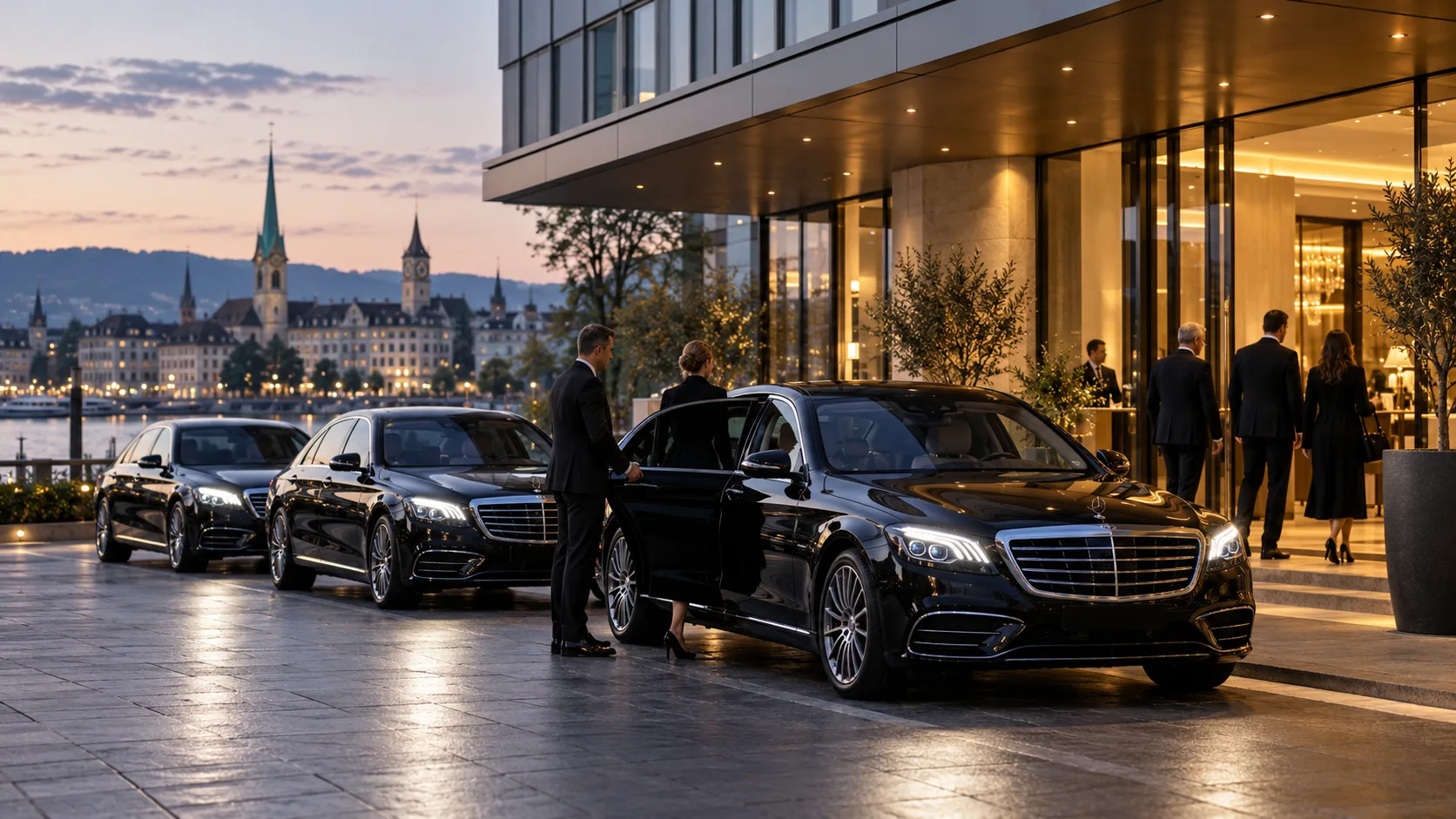
VIPs and keynote speakers should almost always be on dedicated cars, not the shuttle, because their timing is both critical and unpredictable. A speaker who misses their slot because the shuttle was full is a disaster that reflects on the whole event. Assign these guests a specific vehicle and, ideally, a consistent driver for the duration, so there is a known, reachable point of contact for each one. Share their schedules with the transport coordinator in advance, and build generous buffers around anything they must not miss.
Discretion matters here too. Senior guests may take calls, review materials, or simply want quiet between engagements. A professional chauffeur who understands that is worth more than a slightly cheaper option that does not. For the broader principles of booking executive transport that holds up under pressure, our EA’s guide to corporate transport covers the detail.
What about peak periods and major events?
If your event falls during a major period such as a large conference or a Davos week, book early and expect constraints. During peak windows, vehicle and driver supply across the region tightens sharply, prices rise, and last-minute requests may simply go unmet. An event planned during one of these windows needs its transport locked in weeks ahead, not days. Confirm not just vehicles but backup capacity, because a breakdown or a sick driver during a fully booked week is much harder to cover. The earlier you commit, the more certainty and the better rate you secure.
How do you handle communication on the day?
The best transport plan fails if guests do not know how to use it, so communication is as important as the vehicles themselves. Guests need to know, before they arrive, where their pickup point is, when shuttles run, and who to contact if something goes wrong. A single-page transport note in the welcome pack, repeated on signage at the hotels and venue, prevents most of the confusion that otherwise clogs the day. If guests are left guessing which car is theirs or where the shuttle stops, even a well-resourced operation looks chaotic.
On the day itself, the transport coordinator should be reachable by a number everyone has, and the drivers should be in contact with that coordinator rather than fielding guest questions directly. This keeps the drivers driving and funnels every change through one person who can see the whole picture. A WhatsApp group or similar channel for the coordinator and drivers, separate from guest-facing communication, lets the operation adapt in real time without the guests ever seeing the machinery move.
What are the most common event transport mistakes?
A handful of mistakes account for most event transport failures, and all of them are avoidable with planning. The first is sizing for the total headcount rather than the peak load, which leaves guests waiting at the busiest moment. The second is underestimating the departure, the end-of-night rush when everyone leaves at once and tired guests have the least patience; this almost always needs more capacity than the arrival did. The third is treating VIPs like general guests and putting them on a shuttle, which works right up until the one time it does not and a speaker misses their slot.
The fourth, and the most insidious, is having no slack. A plan with no buffer collapses the moment one thing runs late, which at any real event it will. Build in margin at every movement, keep a vehicle or two in reserve, and the inevitable small delays stay small instead of cascading. An event transport plan that assumes everything runs to the minute is not a plan, it is a hope.
A planning checklist for event transport
- Map every movement moment, from airport arrivals to the final departure, and find the peak loads.
- Size vehicles for the peak, not the total headcount.
- Decide the shuttle-versus-dedicated split, and communicate shuttle times clearly.
- Put VIPs and speakers on dedicated cars with known drivers and generous buffers.
- Assign one transport coordinator as the single point of contact on the day.
- Plan the departure, the hardest moment, with extra capacity for the end-of-night rush.
- Book early for peak periods and confirm backup capacity.
Event transport done well is a quiet success: guests arrive relaxed, speakers hit their slots, and the night ends without a scrum at the door. All of that comes from planning the movements before the event, not managing them during it.
Flyyt plans and runs ground transport for corporate events in Zurich: airport arrivals, hotel-to-venue shuttles, dedicated VIP cars, and end-of-night departures, with one coordinator managing the whole operation. See our corporate and event transport services.