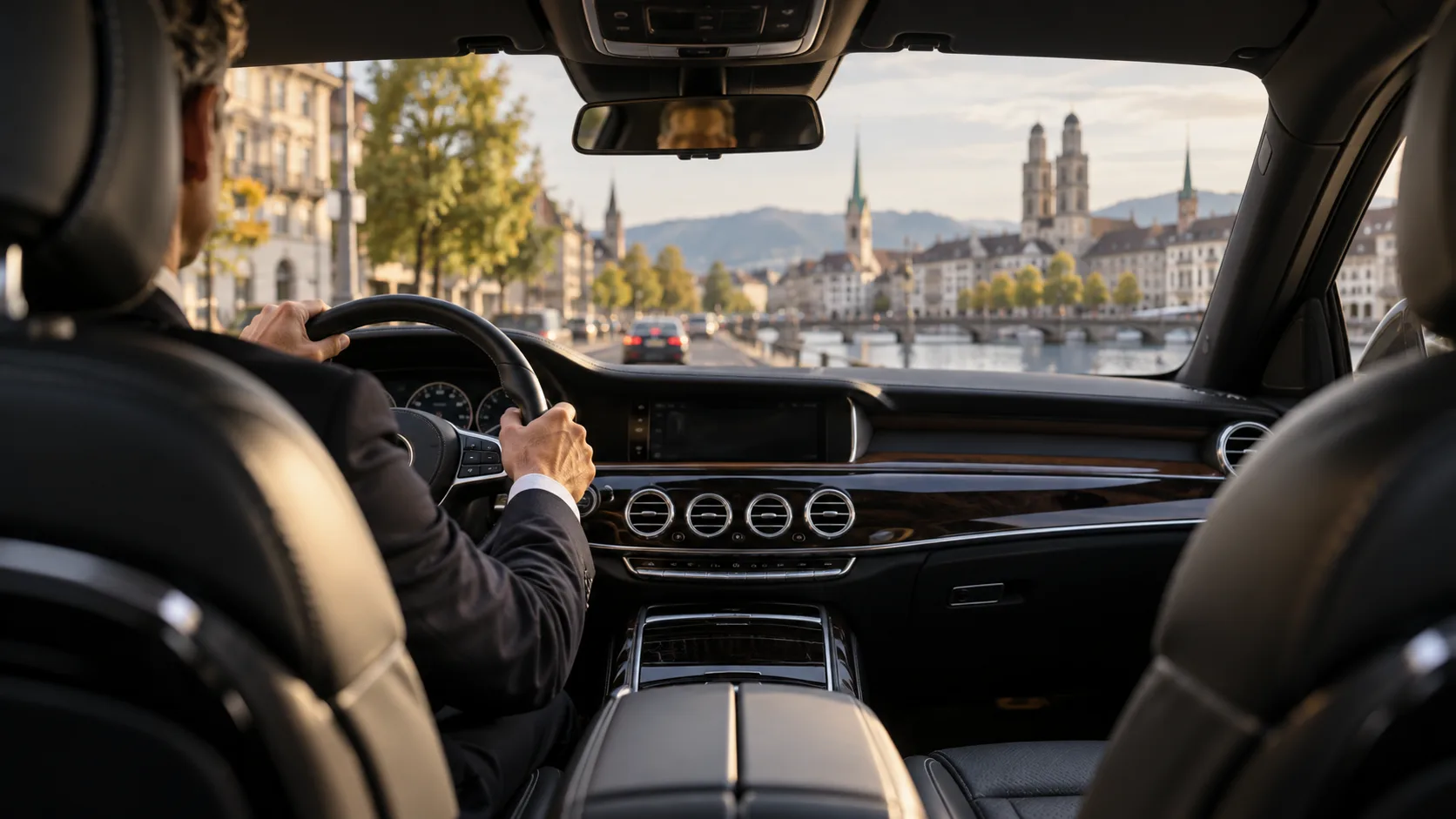
At first glance, hiring a chauffeur looks like a luxury, a status symbol, the sort of thing you do because you can rather than because you should. And sometimes it is exactly that. But for a lot of senior people, the decision to stop driving themselves has nothing to do with status and everything to do with arithmetic. When you put a real number on an executive’s time, the chauffeur stops looking like an indulgence and starts looking like one of the more rational line items in the budget.
This piece makes the honest case for why executives hand off the driving, based on the value of recovered time, the cost of risk, and the things a car cannot give you when you are the one behind the wheel. We provide chauffeur services, so this is not a neutral source, but the argument stands on its own and we have tried not to oversell it. For plenty of trips, driving yourself or taking a train is perfectly sensible, and we will say where.
What is an hour of commute actually worth?
The core of the case is simple: a senior executive’s time has a high value, and driving converts that time from productive to wasted. Consider someone whose work generates significant value per hour. Every hour they spend with both hands on the wheel and their attention on the road is an hour that cannot be spent preparing for a meeting, reviewing a document, taking a call, or simply arriving rested and sharp. Over a week of commutes and inter-city trips, that adds up to a meaningful block of lost productive time.
A chauffeur converts that time back. The back seat of a quiet car becomes a mobile office or a decompression space. The executive reviews the deck on the way to the pitch, takes the call they could not take while driving, or closes their eyes for twenty minutes before a demanding afternoon. The fare, measured against the value of the hours it recovers, is often comfortably positive. This is the calculation that turns a chauffeur from a perk into a tool, and it is why the decision is frequently made by finance rather than vanity.
What about the risk and the hidden costs of driving?
Driving yourself carries costs that do not show up on any invoice: the risk of an accident, the stress of traffic, the search for parking, and the fatigue of doing it after a long day. A senior person driving themselves to an evening event after a full day is not operating at their best, and the marginal risk of a late-night drive home is real. Removing that is worth something, even if it is hard to price precisely.
Then there are the frictions that quietly erode a day: the circling for parking in central Zurich, the cost of that parking, the mental load of navigation and traffic, the irritation of arriving flustered. None of these are catastrophic on their own, but together they tax the exact faculties an executive is paid to bring to the room. Arriving calm, prepared, and on time is not a small thing when the next hour decides a deal.
Why not just use a taxi or Uber each time?
For a one-off ride, a taxi or Uber is fine and cheaper, but for a regular pattern, a chauffeur offers consistency and continuity that on-demand services cannot. The executive who uses the same service repeatedly gets a known standard of car, often a familiar driver, and a provider who learns their preferences and schedule. There is no fresh negotiation of quality at every trip, no surge pricing on the evening it matters, no roll of the dice on whether the car that arrives is suitable for a client meeting.
This is not an argument that a chauffeur beats a taxi for everything. It plainly does not for a single spontaneous ride, and we explore that trade-off honestly in our comparison of a chauffeur, Uber, and taxi. The case for a chauffeur is specifically about a recurring, high-value pattern, where the reliability and continuity compound over time and the lowest-fare-per-trip logic of a rideshare misses the point.
What does the back seat actually enable?
The value of a chauffeur is not abstract; it comes down to specific things the executive can do in the back of the car that they cannot do behind the wheel. They can take a call, including a confidential one, which is impossible to do safely while driving and awkward to do on a train. They can read and annotate a document, rehearse a presentation, or work through email, turning a dead forty minutes into a productive block. They can hold a working conversation with a colleague travelling alongside them, effectively extending the meeting into the journey.
Equally, they can do nothing at all, deliberately. A few minutes of quiet with eyes closed before a demanding engagement is its own kind of value, and arriving composed rather than wound up from traffic changes how the next hour goes. None of this is available to the person driving, whose attention is necessarily on the road. The back seat is not a comfier version of the driver’s seat; it is a fundamentally different space that returns the executive’s attention to them.
How does this look over a month, not a trip?
The case for a chauffeur is clearest when you stop thinking about a single ride and look at the pattern over a month. One commute converted from driving to working is a modest gain. Twenty of them, plus a handful of inter-city trips and evening events, add up to a substantial block of recovered high-value time, together with a month free of parking hassles, late-night drives, and the small daily erosion of composure that self-driving brings. Measured monthly against the value of that time and the reduction in risk and friction, the recurring cost of a chauffeur is often easy to justify in a way that a single fare, viewed in isolation, is not.
This is also why a corporate account tends to make more sense than ad hoc bookings for this profile. A known rate, a consistent pool of drivers, and a single monthly invoice turn the whole arrangement into a predictable, manageable line item rather than a series of decisions. The executive stops thinking about transport entirely, which is the real goal.
When does driving yourself still make sense?
Honesty requires naming the cases where the chauffeur is the wrong call. If the trip is short, infrequent, and low-stakes, the overhead of a booked car is not worth it. If the executive genuinely enjoys driving and finds it restorative, that is a real benefit a chauffeur removes. And for someone whose time is not at the high end of the value scale, the arithmetic that makes the chauffeur rational simply does not apply with the same force. The case here is strongest for senior people with dense, high-value calendars and frequent travel, and it weakens as you move away from that profile.
The bottom line
Executives hand off the driving when the value of their recovered time, plus the reduction in risk and friction, exceeds the fare, which for a busy senior calendar it usually does. It is less a lifestyle choice than a straightforward allocation of a scarce resource, which is attention. The chauffeur is not buying a nicer seat. It is buying back the hours and the composure that driving quietly consumes. For the question of how to book that reliably once you have decided, see our EA’s guide to corporate transport.
Flyyt provides executive chauffeur services in Zurich that turn travel time into working or resting time, with consistent professional drivers, a known standard of vehicle, and corporate accounts for regular patterns. See our executive chauffeur services.