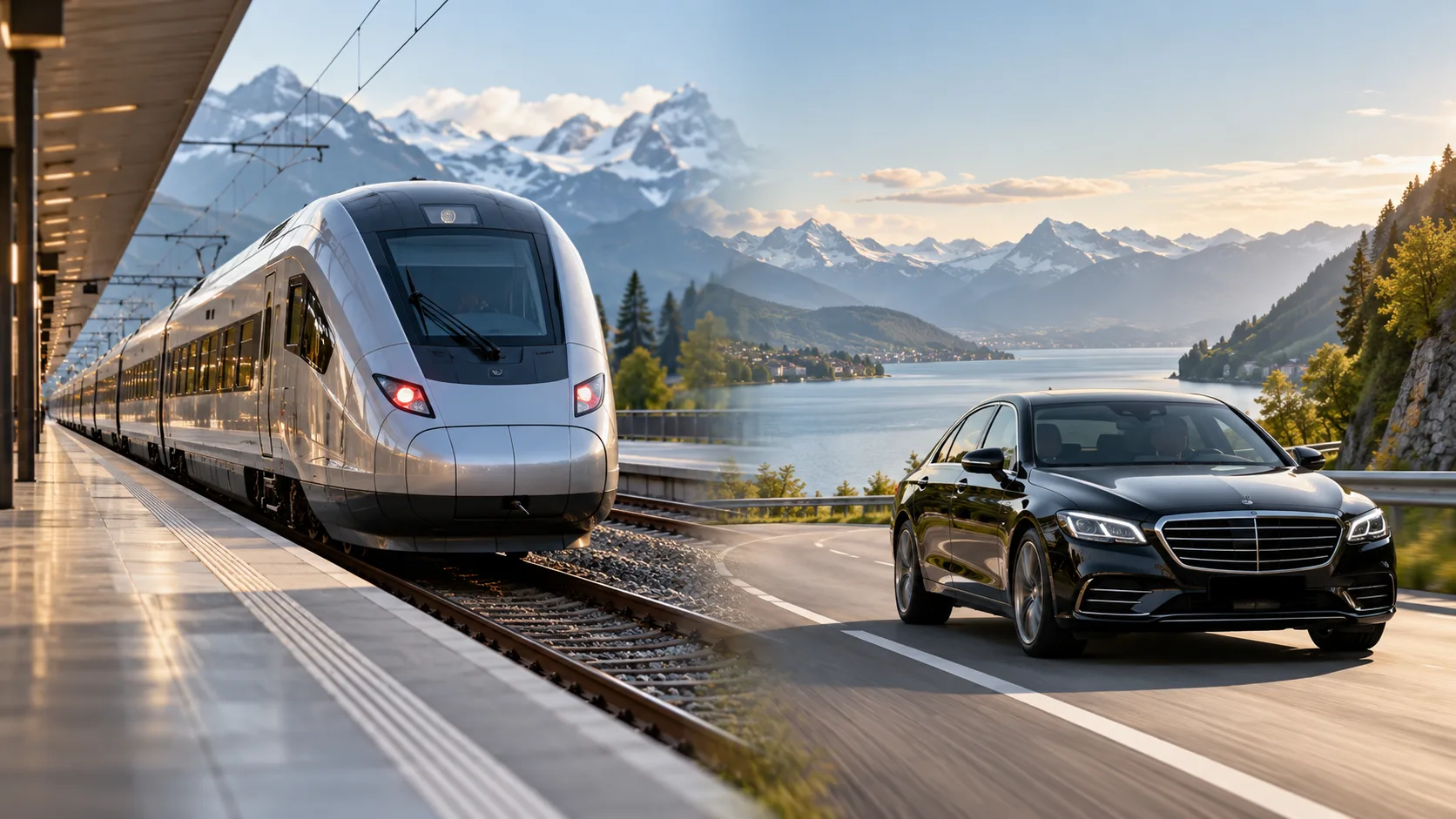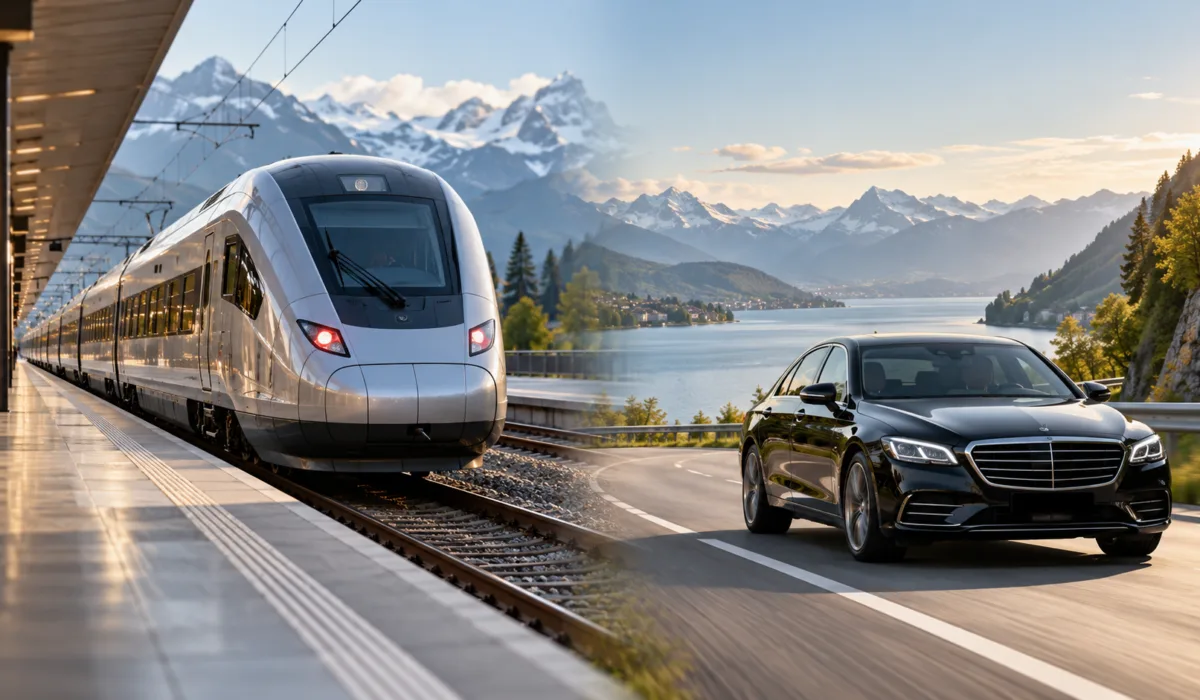
Switzerland has what is probably the finest rail network in the world. Trains run on time to the minute, reach almost everywhere, and offer some of the most beautiful journeys on the planet through the window. So any honest comparison of the train against a private transfer has to start by admitting that the train is genuinely excellent and, for a great many trips, the right choice. The interesting question is not whether the train is good. It is which specific kinds of journey favor a private car instead, and why.
This guide compares the Swiss train and a private transfer fairly, covering cost, time, comfort, and the trips where each one clearly wins. We run private transfers, so weigh our view accordingly, but we are not going to pretend the train is anything other than superb for the journeys it suits. It suits a lot of them. The goal is to help you tell which trip is which.
Why is the Swiss train so hard to beat?
For a solo traveler or a couple on a point-to-point journey between cities, the train is usually the best option, full stop. It is cheaper than any private car. It runs frequently, often every half hour on major routes. It is punctual to a degree that genuinely surprises visitors. The main stations sit in city centers, so you arrive where you want to be. And you can work, read, eat, or simply watch the Alps go by, with no driving and no parking to worry about at the other end.
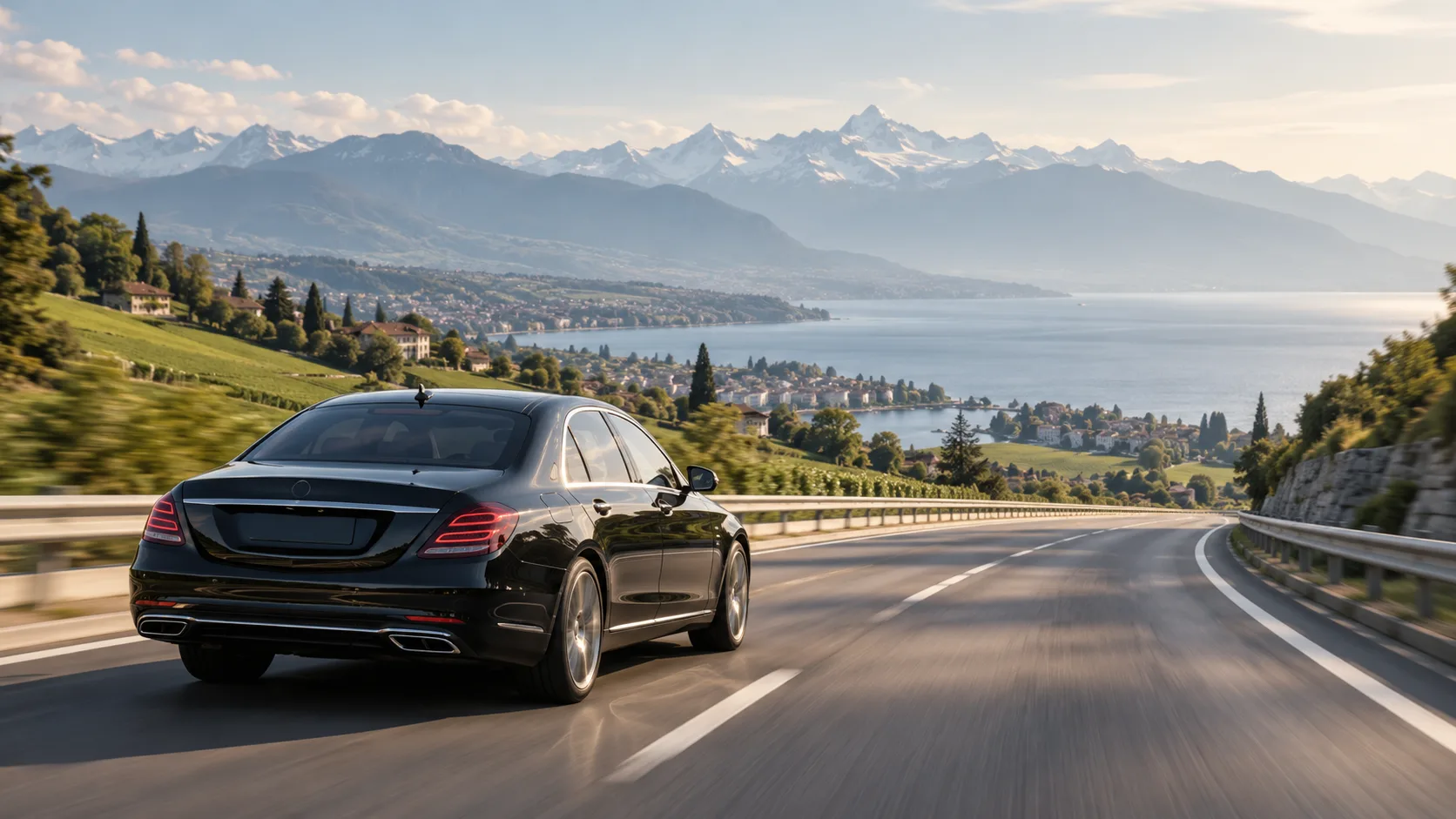
The scenery deserves its own mention. Routes like the one along Lake Geneva, or the climbs into the mountains, are attractions in their own right. If the journey is part of the pleasure of your trip, the train is not a compromise, it is the point. For independent travelers who value economy and do not mind a timetable, the train is close to unimprovable, and we will cheerfully recommend it.
Where does the train become less convenient?
The train’s weaknesses show up at the ends of the journey, with luggage, with groups, and when the timetable does not match your day. None of these make the train bad. They make it the wrong tool for certain trips.
Start with the ends. The station is central, but your actual start or finish often is not. A suburban hotel, a private home, a conference venue, or the airport each add a connecting leg, which means a local train, a tram, or a taxi with your bags at each end. For a single traveler this is a minor nuisance. With three colleagues, a family, or several large cases, the choreography of changes, platforms, and crowded carriages stops being relaxing and starts being work.
Then there is the timetable. The train runs when the train runs. Usually that is fine, given the frequency, but on a day with a tight and important schedule, or an unusual hour, or a plan that keeps shifting, being tied to departure times becomes a constraint. Miss a connection with luggage and children and the excellent Swiss rail network suddenly feels less forgiving.
When is a private transfer clearly worth it?
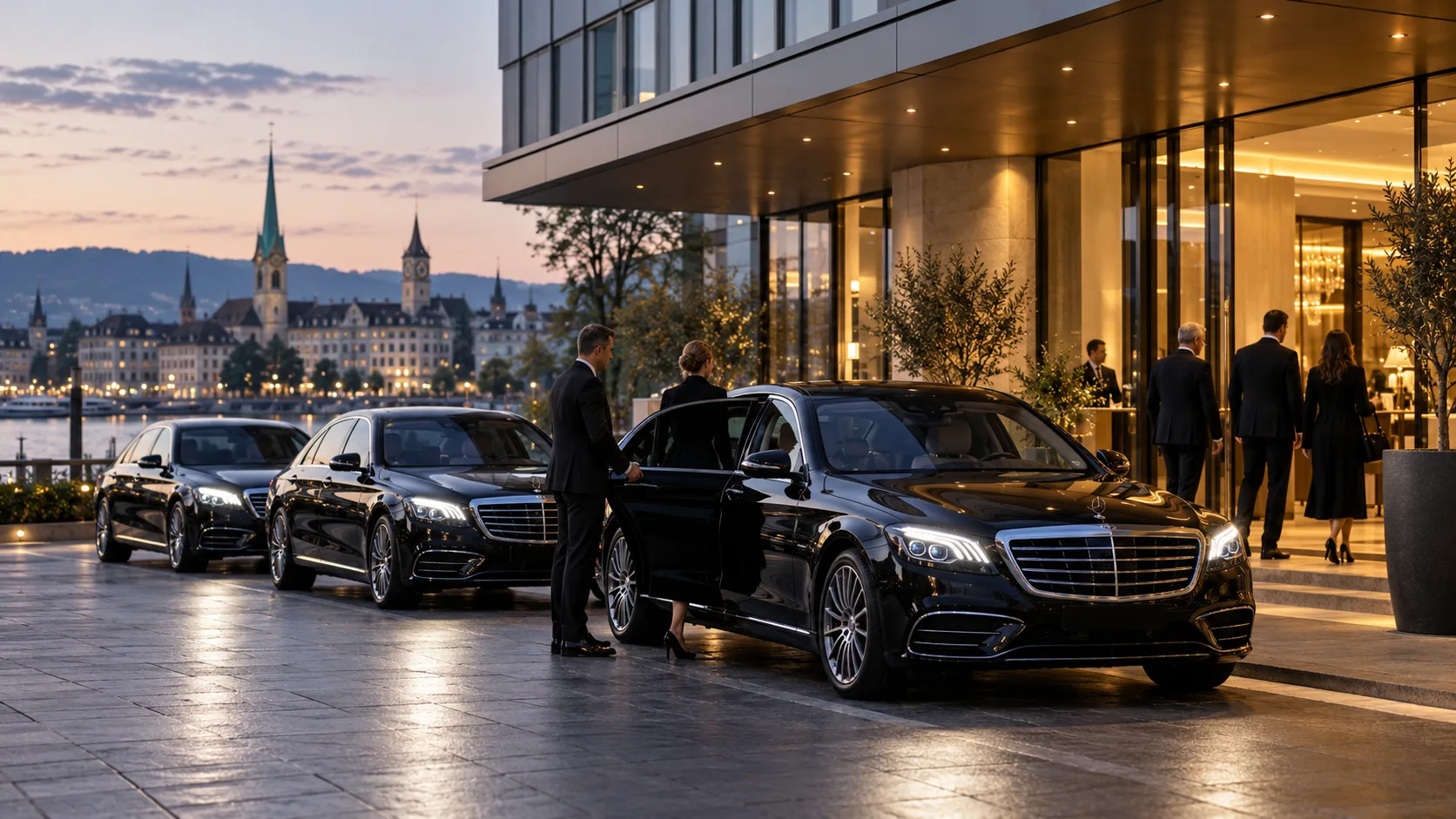
A private transfer wins when the trip involves a group, significant luggage, an airport leg, door-to-door needs, or a schedule where certainty matters more than saving money. In those cases the economics and the comfort both tilt toward the car.
- Groups of three or more: the per-person cost of a private van closes on, and sometimes undercuts, several separate train tickets, while giving you door-to-door service and a single shared space.
- Heavy or awkward luggage: ski gear, multiple suitcases, equipment. Loaded once into the boot and handled by the driver, rather than wrestled across platforms.
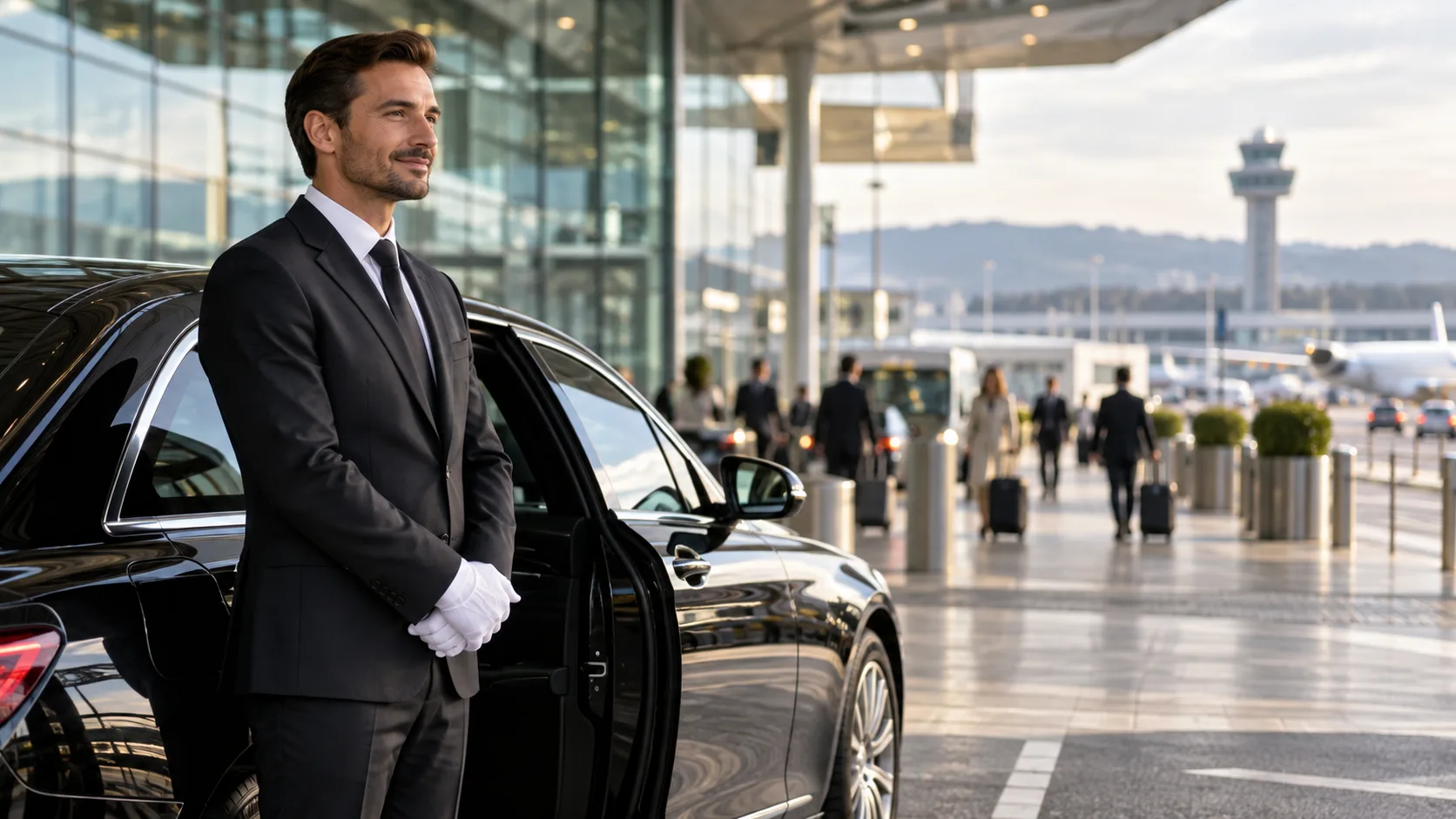
- Airport arrivals and departures: a car collects you from the terminal and takes you to your exact destination, skipping the airport-to-station-to-train-to-hotel chain. Our guide to Zurich Airport transfers walks through that first leg.
- Door-to-door with no changes: for anyone who would rather not manage connections, especially after a long flight or before an important meeting.
- Schedule-critical days: when arriving exactly on time, exactly as planned, is worth paying a premium for.
Does the cost comparison change with group size?
Yes, and this is the factor people most often get wrong. The train’s price advantage is largest for one person and shrinks fast as the group grows. A single rail ticket is cheap, so for a solo traveler the train wins on cost by a wide margin. But rail tickets are priced per person, while a private transfer is priced per vehicle. Put four people in the same car and you are splitting one fare four ways, which can bring the per-head cost close to, or below, four separate train tickets, before you even count the door-to-door convenience and the luggage space you gain.
The crossover point depends on the route and the fares, but the direction is always the same: the more of you there are, the better the private car looks on pure economics, quite apart from comfort. For a couple, the train usually still wins on price. For a family of four or a team of colleagues, run the actual numbers rather than assuming the train is cheaper, because it often is not once you total the tickets and add the connecting legs at each end.
What about comfort and productivity on the journey?
Both the train and a private car let you work rather than drive, but they offer different kinds of space. The train gives you a table, usually good connectivity, and the option of a quiet carriage, which many people find ideal for focused work on a laptop. The trade-off is that it is a public space: you cannot take a confidential call freely, the seat next to you may fill, and a crowded carriage on a busy route is not restful.
A private car gives you a contained, private space where a sensitive call is genuinely private, where the group can talk freely, and where you control the environment. It is the better choice when the journey itself is working time that needs discretion, or when you want to arrive genuinely rested rather than merely transported. For a leisurely solo journey through beautiful scenery, the train is arguably the nicer experience. For a working leg before a demanding meeting, the private car usually wins.
The honest bottom line
Choose the train when you are traveling light, traveling alone or as a couple, watching the budget, and happy to work with a timetable. It is cheaper, it is lovely, and for those trips nothing we offer improves on it meaningfully. We would rather you took the train and had a good day than paid us for certainty you did not need.
Choose a private transfer when you are a group, when luggage or logistics are heavy, when an airport is involved, or when the day is one you cannot afford to leave to a timetable. In those cases the car is not an indulgence, it is the sensible choice, and the premium buys real value in comfort, time, and peace of mind. For the specific Zurich-to-Geneva decision, our dedicated guide to that route runs the numbers in detail.
Most travelers in Switzerland will use both over a trip, and that is exactly right. The skill is matching the mode to the journey rather than committing to one out of habit.
When the train is the wrong tool for the trip, Flyyt runs private transfers across Switzerland at a fixed price agreed in advance, door to door, with room for your group and luggage and flight tracking on airport legs. See our Switzerland city transfers.