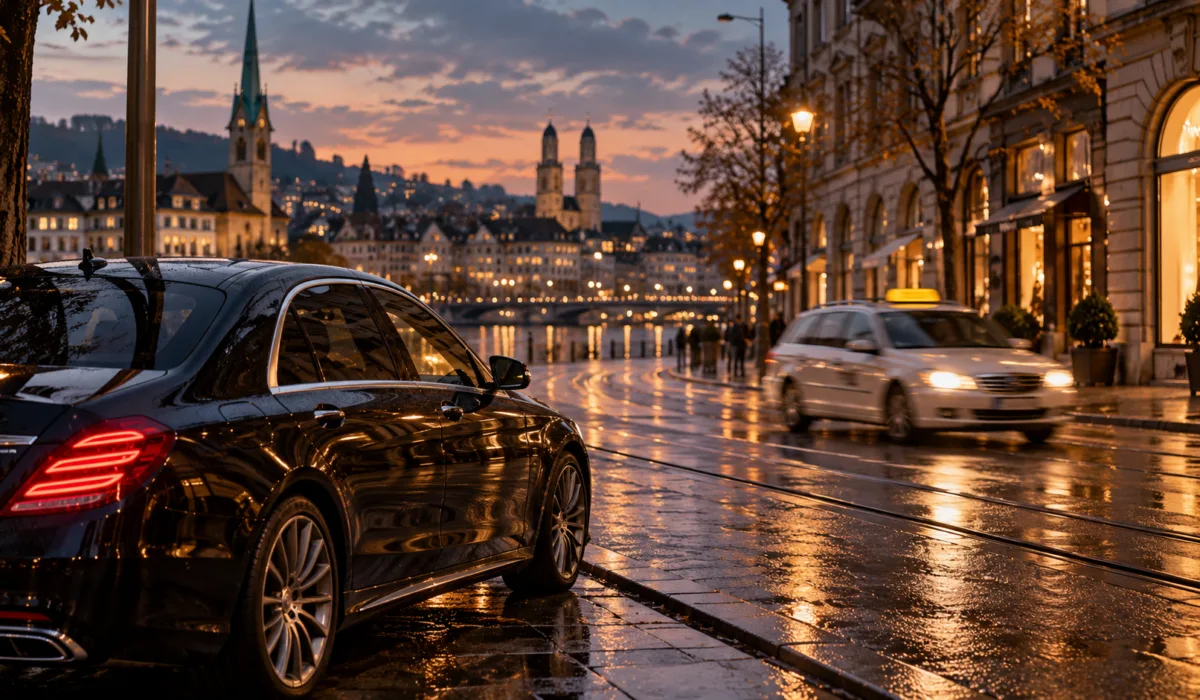
Getting around Zurich is rarely the hard part. The city has one of the best public transport systems in the world, taxis queue outside every station, and Uber works much the way it does anywhere else. The hard part is deciding which of these you actually want for a given journey, because the honest answer changes depending on what the trip is for. A late-night ride home across the city is not the same problem as a 7 a.m. airport run with three suitcases and a flight to catch, and the option that wins the first is rarely the one that wins the second.
This guide compares the three realistic ways to get a car with a driver in Zurich: a licensed taxi, Uber, and a private chauffeur. It covers what each one actually costs, how reliable each is in practice, and the specific situations where one clearly beats the others. We run a chauffeur service, so we have a view, but we have tried to be straight about where a taxi or an Uber is the smarter call, because pretending otherwise helps nobody and you will work it out on your own anyway.
What does a taxi cost in Zurich, really?
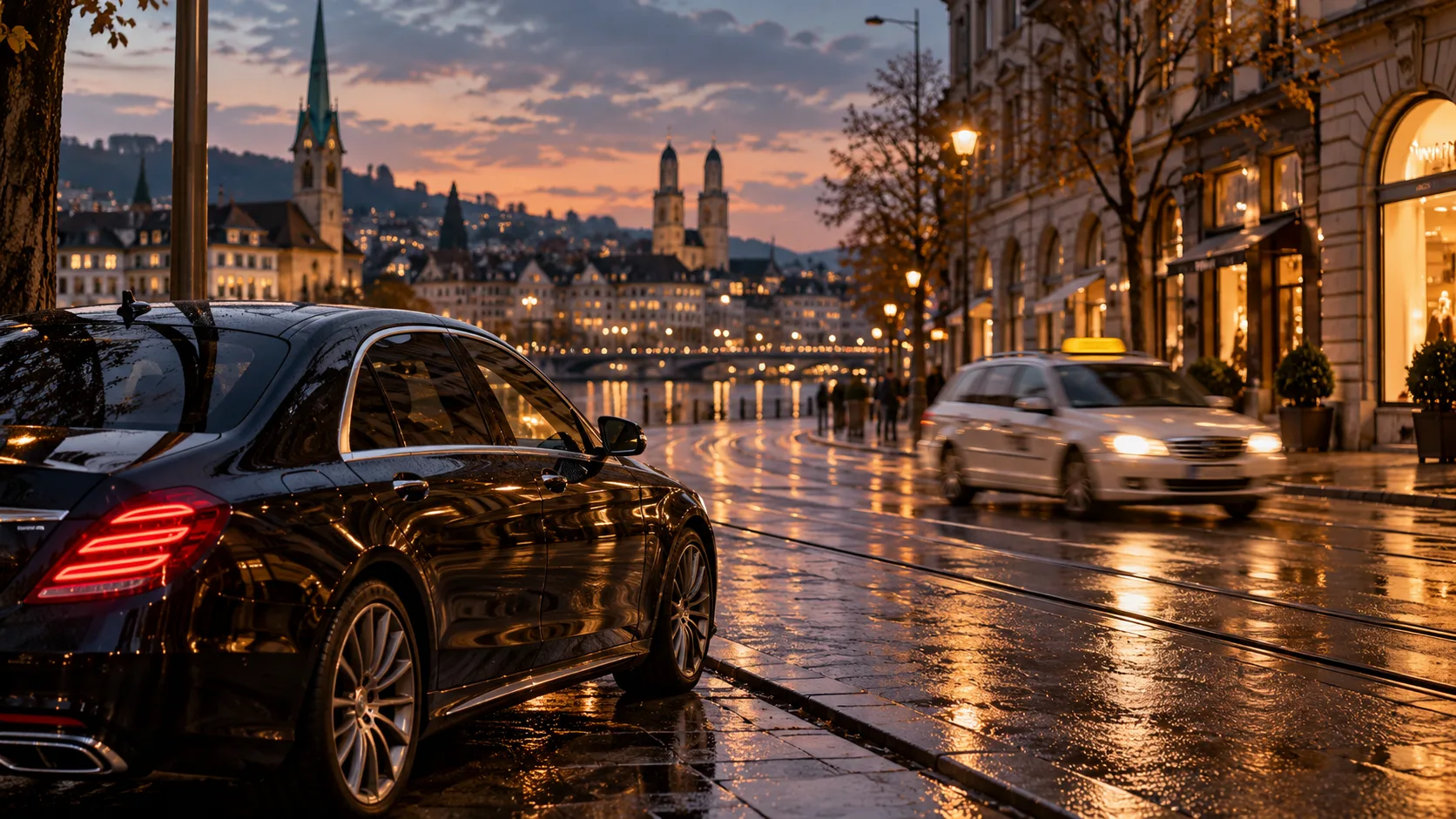
Zurich taxis are metered and among the most expensive in Europe, typically starting around CHF 6 to 8 and then charging roughly CHF 3.80 to CHF 5 per kilometer, with higher rates at night and on Sundays. A short hop across the city center might land between CHF 20 and CHF 35. The standard run between Zurich Airport and the city center usually falls somewhere in the CHF 50 to CHF 70 range, and more if traffic is heavy or you are caught in an evening tariff. There is no haggling and no app required: taxis are street-hailable, wait at ranks outside the main station and the airport, and can be booked by phone.
The appeal of a taxi is that it is always there and requires zero planning. You do not need an account, a working data connection, or any forethought. You walk out of a restaurant, raise a hand or walk to the nearest rank, and you are moving within a couple of minutes. For a one-off ride where you simply need to get from A to B and cost is not the deciding factor, this is hard to beat for sheer convenience.
The weaknesses are equally real. The meter keeps running in traffic, so a fixed-looking trip can quietly become expensive on a bad day. Vehicle quality varies: you might get a spotless E-Class or a tired older car, and you do not get to choose. Drivers are licensed and professional, but there is no relationship and no continuity, and if you are heading to the airport there is no one tracking whether your inbound logistics are going to plan. A taxi is a transaction, complete the moment you step out, which is exactly what you want some of the time and not at all what you want the rest of it.
How does Uber work in Zurich, and what does it cost?
Uber operates legally in Zurich with licensed drivers, and it is usually cheaper than a taxi for the same trip, often around CHF 1.80 to CHF 2.50 per kilometer in normal conditions, but the price moves with demand. An UberX across the city might come in meaningfully below the equivalent taxi fare on a quiet afternoon. The catch is surge pricing: during rush hour, bad weather, major events, or late on a weekend night, fares can climb to one and a half, two, or even three times the base rate, which is precisely when you are most likely to need a ride and least able to find an alternative.
What you get with Uber is transparency and control through the app. You see a price estimate before you commit, you watch the car approach on a map, payment is automatic, and there is a record of every trip. For visitors, there is also comfort in the familiarity: the experience is the same one you know from home, in English, with no language barrier at the point of booking. Switzerland tightened its rules in recent years so that Uber drivers here are properly employed and licensed, which has improved consistency compared to the early days.
Where Uber falls down is reliability at the margins. Availability is thinner than in a city like London or New York, so at odd hours or in outlying areas you may wait longer than expected or watch the estimate climb while you refresh. The driver who accepts your airport pickup has no particular stake in your flight: if they cancel, you are back in the queue at the worst possible moment. And as with a taxi, every ride is a fresh roll of the dice on the car, the driver, and the route. For everyday trips this is fine. For anything where the downside of a problem is large, the variance is the issue.
How is a private chauffeur different?
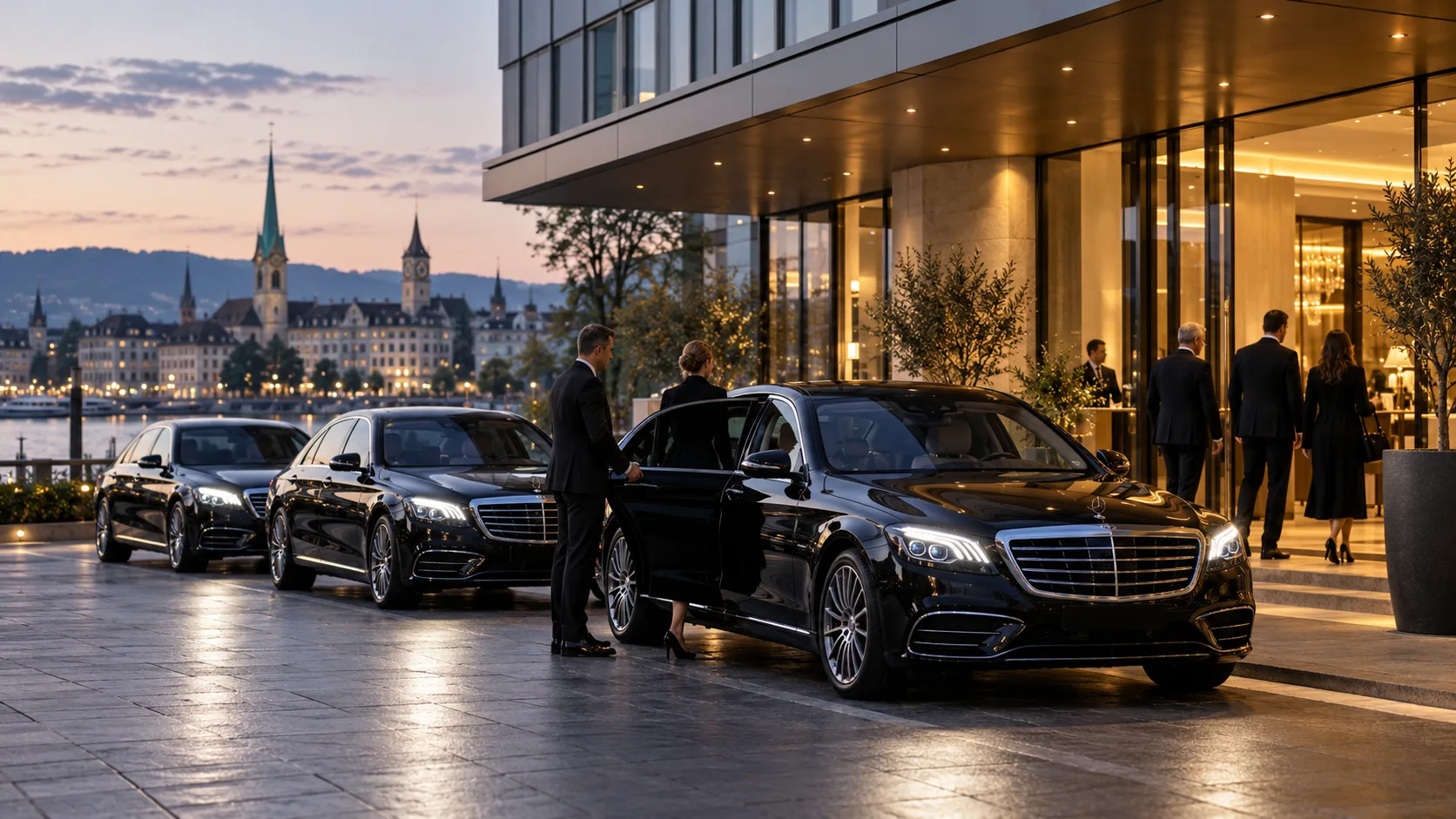
A private chauffeur is a pre-booked, fixed-price service with a professional driver assigned to you, where the whole point is that nothing about the journey is left to chance. You agree the price before the car moves, so there is no meter and no surge. The driver knows your pickup time, your destination, and your flight details if it is an airport run. The vehicle is a known quantity, clean and in the executive class you booked. And if your plane lands early or three hours late, the chauffeur is tracking it and adjusts, rather than giving up on a fare that is no longer convenient.
This is a different product from a taxi or an Uber, not just a pricier version of the same thing. The taxi and the rideshare both solve the problem of getting a car in the next few minutes. The chauffeur solves the problem of being certain, hours or days in advance, that a specific car will be in a specific place at a specific time, with a specific standard of service, at a price you already know. You are not paying extra for a fancier seat. You are paying to remove the variables.
Honesty requires naming the trade-off: a chauffeur is the most expensive of the three for a simple point-to-point ride, and it requires booking ahead rather than summoning on a whim. If all you need is to cross town on a quiet Tuesday, booking a chauffeur is using a tool far heavier than the job demands. The value only appears when the certainty is worth paying for, and that depends entirely on the trip.
The honest head-to-head
Put side by side, each option has a clear territory where it is the right answer. None of them is best at everything, and anyone who tells you otherwise is selling something.
- Cheapest for a quick, spontaneous ride: Uber usually wins on price in normal conditions, with the taxi close behind and no app required. The chauffeur is the wrong tool for this job.
- Most available on the spot, no planning: the taxi, every time. Ranks at the station and airport, hailable on the street, no account, no waiting for a driver to accept.
- Most predictable price: the chauffeur, with a fixed quote agreed in advance. The taxi meter and Uber surge both introduce uncertainty, and surge introduces the most.
- Best for an airport run with a flight to catch: the chauffeur, because flight tracking, a guaranteed car, and a driver who waits if you are delayed are built in rather than hoped for.
- Best for a visitor who wants the familiar: Uber, with its known app, in-app English, map tracking, and automatic payment.
- Best for several hours of stops, waiting, and changes of plan: the chauffeur booked by the hour, where the car and driver stay with you rather than being re-summoned at each stop.
- Best when vehicle quality and consistency matter: the chauffeur, since the car and standard are known before you book rather than whatever turns up.
Notice that the chauffeur does not win the rows about price or spontaneity, and that is the point. It wins the rows about certainty, continuity, and consequence. If your trip does not turn on any of those, a taxi or an Uber is the sensible, cheaper choice, and you should take it with a clear conscience.
So which should you actually book?
Match the tool to the stakes of the trip, not to a general preference. For a casual ride across the city where a ten-minute wait or a slightly variable fare costs you nothing, open Uber or walk to a taxi rank. There is no reason to pay chauffeur rates to cross the Limmat for dinner.
Book a chauffeur when the downside of something going wrong is real: a morning flight you cannot miss, a client you cannot keep waiting, a wedding or an important dinner where arriving flustered is not an option, or a long day of meetings and sightseeing where you want one driver and one car for the whole stretch. In those cases the premium buys you the one thing the other two cannot guarantee, which is that the car will simply be there, as agreed, whatever the day throws at it. If you are weighing it up on price alone, our breakdown of what a private driver in Zurich actually costs lays out the real numbers, and when hiring a chauffeur by the hour makes sense covers the multi-stop days where it earns its keep.
Most people in Zurich end up using all three, and that is the right instinct. The skill is not loyalty to one option but knowing which trip is which. Spend lightly on the rides that do not matter, and spend deliberately on the ones that do.
When the trip is one you cannot afford to get wrong, Flyyt provides a private chauffeur in Zurich at a fixed price agreed in advance, with a professional driver and a car you can count on. Book by the hour or point to point, with flight tracking on every airport run. See our private driver and hourly chauffeur service.