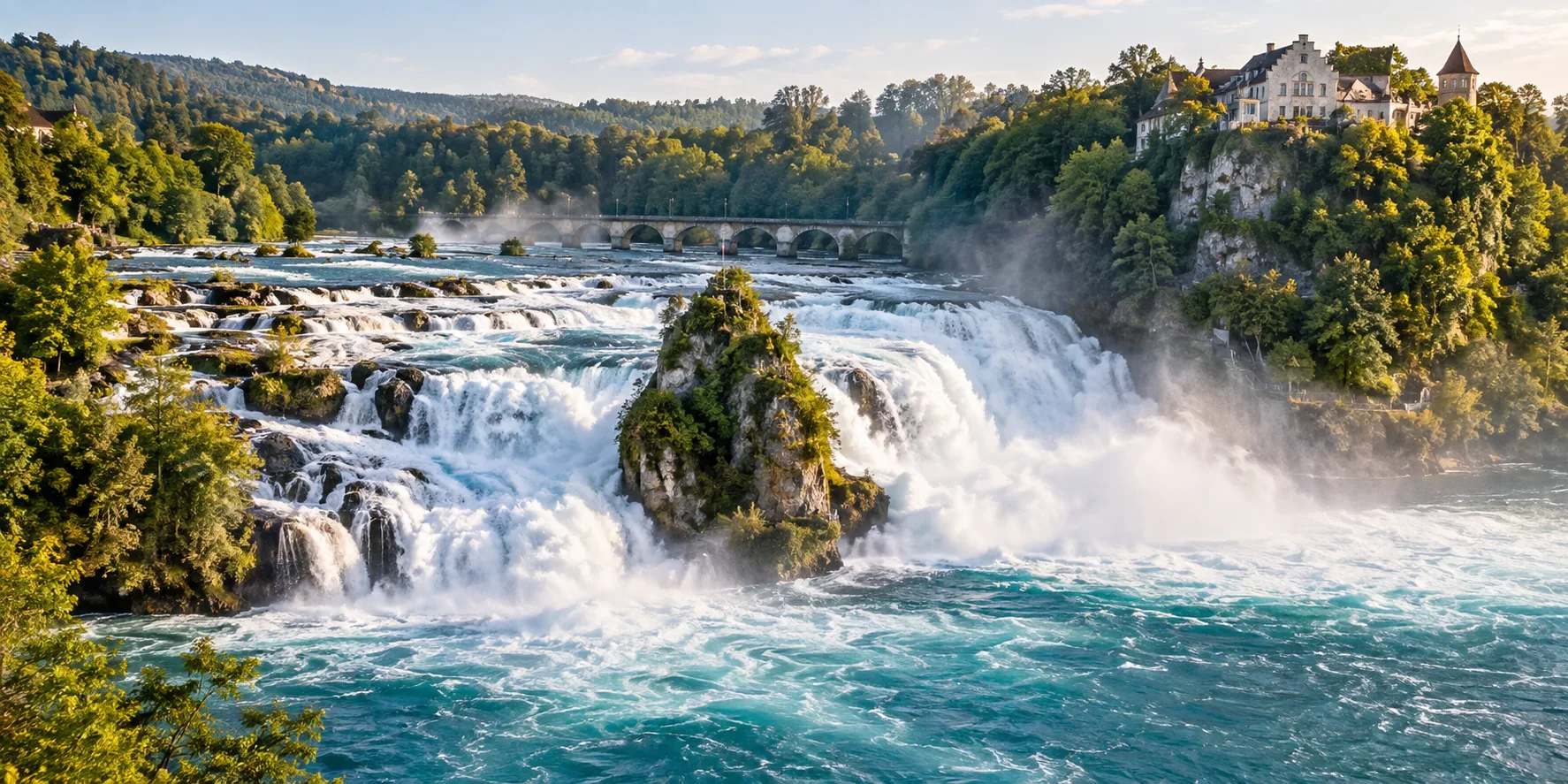
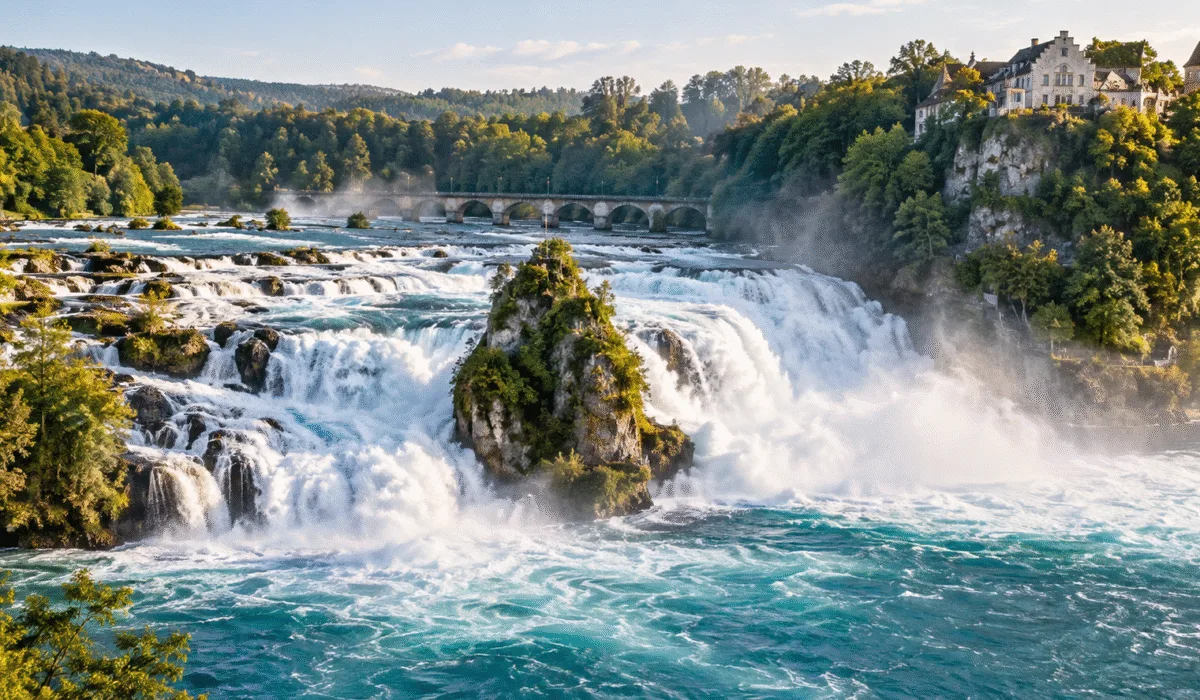
Some sights announce themselves before you see them. At the Rhine Falls, it is the sound. You hear it a full minute before the water comes into view, a low and constant roar that you feel in your chest as much as your ears. Then the trees part and there it is, a wall of white thunder flinging spray high into the air, with a single defiant tower of rock standing in the middle of the chaos. It is loud, it is genuinely wet, and it is one of those rare natural spectacles that lives up to every photograph you have seen of it.
The best part for anyone staying in Zurich is how close it is. The Rhine Falls sits barely an hour from the city, which means you can be standing in the spray by mid-morning, share a lakeside lunch in a medieval town at noon, and be back in Zurich in time for dinner. This guide covers how to reach it, which side of the river to choose, whether the famous boat rides are worth it, when to go, and how to turn a simple waterfall visit into one of the finest days out in northern Switzerland.
How far is the Rhine Falls from Zurich?
The Rhine Falls lies near the towns of Schaffhausen and Neuhausen in northern Switzerland, roughly 45 to 60 minutes from Zurich by car. By public transport the journey takes a similar 50 minutes or so, but it usually involves a train to Schaffhausen or Neuhausen, a change, and then a short walk or local connection to the falls themselves. It is entirely doable, and Swiss trains are famously punctual, but it is fiddlier than the distance suggests, especially with children, luggage from a recent flight, or camera gear you would rather not juggle across platforms.
With a private driver the calculation changes. You are collected from your hotel or the airport, driven straight to the entrance, and met again at an agreed time, with no timetable to watch and no changes to navigate. For a relaxed day, that door-to-door simplicity is the difference between an outing and an errand.
What makes the Rhine Falls so special?
It is the largest waterfall in Europe, and the scale is the whole point. The falls stretch 150 metres across and drop 23 metres, and in the high-water months of early summer several hundred cubic metres of water thunder over the edge every second, swollen by melting Alpine snow. Standing on the lower platforms, close enough to taste the mist, those numbers stop being abstract. You feel the ground vibrate.
There is history layered into the geology, too. At one point in the 19th century there were serious proposals to blast the rocks away to open the river to shipping, a plan that thankfully came to nothing. To this day, no boat can pass the falls, which is part of why the little vessels that nose up to the base feel so daring. The whole site is also refreshingly open. The falls are freely accessible 365 days a year, around the clock, and you can admire them from the northern bank without paying a single franc.
Which side of the Rhine Falls should you visit?
The river divides the experience into two banks, each with its own character. Understanding the difference is the single most useful thing to know before you go, because it shapes your whole day.
Schloss Laufen, the south bank: drama and platforms
This is the theatrical side. The thousand-year-old Schloss Laufen castle sits directly above the falls, and from its terraces and gardens you look straight down onto the roaring edge. From the castle, a series of stairways and walkways, the Belvedere trail, leads down toward the water and ends at a cluster of viewing platforms with wonderful names: Belvedere, Kanzeli, and Fischetz. The Kanzeli juts out almost over the torrent, close enough that a rain jacket is a genuinely good idea.
Entry to this side costs around CHF 5 for adults and CHF 3 for children, which includes the viewing platforms, the panoramic glass lift, and the Historama, a small exhibition on the origins and history of the falls. The glass lift is worth a mention of its own: it runs between the castle level and the Belvedere platform, and the ride is a small thrill in itself. Parking on this side is free, and the Belvedere platform and its trail are barrier-free, reachable without steps, which makes this bank workable for wheelchairs and pushchairs as far as the main viewpoint. One neat trick locals use: walk down via the trail and take the lift back up.
Schlossli Worth, the north bank: free, flat, and the boat docks
The northern bank at Neuhausen is free to enter and easier underfoot. The views sit a little further from the falls, but there is a lovely riverside promenade, a playground, restaurants, and, crucially, the main boat departure docks. Schlossli Worth is a small castle on a tiny island reached by a pedestrian bridge, home to an excellent restaurant if you fancy lunch with a view of Europe’s largest waterfall. Many visitors do the sensible thing and see both sides, walking one bank and taking a boat across to the other.
Are the Rhine Falls boat rides worth it?
Yes, and for most people they are the highlight of the day. Several small boats work the basin, run mainly by the operator Rhyfall Mandli, and they come in colour-coded lines that each take a slightly different route. The one everyone talks about is the rock tour, often called the Rock Experience, on the yellow line. It carries you out to the great central rock, drops you at its foot, and lets you climb a stairway to a viewing deck right in the heart of the falls, with white water wrapped around you on every side. The full round trip, including the stop, takes around 30 minutes. There is also a shorter 15-minute basin ride that still brings you thrillingly close, and a simple red-line crossing that ferries you between the two banks.
A few practical notes that will save you time. Boat tickets are bought from the operators at the docks rather than at the castle ticket office, and prices run roughly CHF 6 to CHF 25 depending on the tour. In peak summer the boats are extremely popular, and on a busy day you may wait an hour or more for a seat, so the smart move is to buy your boat ticket first and plan your walking and lunch around the departure time. The 2026 season runs long, roughly late February through early November, though exact daily times shift with the season, weather, and water level. The boats sail rain or shine, so dress for spray. And yes, you will get wet on the lower platforms and the rock, so a light rain cape earns its place in your bag.
When is the best time to visit the Rhine Falls?
For raw power, come in late spring and early summer, when the Alpine snowmelt pushes the falls to their thunderous peak. For elbow room, timing within the day matters as much as the season. The busiest window runs roughly 11:00 to 15:00 in July and August, when coach tours arrive together and the Kanzeli platform fills up. Arrive early in the morning or come later in the afternoon and you will have far more space, better light for photographs, and a shorter wait for the boats.
Winter has its own quiet appeal. The boats generally stop running from around November to late February, so it becomes a platforms-only experience, but the falls remain every bit as spectacular, often with fewer people and a crisp stillness to the air. And if you happen to be in the area on 31 July, stay into the evening for Fire on the Rocks, the annual fireworks display staged over the illuminated falls, which you can watch free of charge from various points around the water.
Is the Rhine Falls accessible for wheelchairs and pushchairs?
Partly, and with a little planning it works well. On the south bank, the Panoramaweg and the Belvedere platform are barrier-free and reachable by the glass lift, so the main viewpoint is accessible. Getting right down to the water and the boat piers involves steps on the south side, but step-free access to the basin can be arranged on the northern bank with advance booking. Special tickets for visitors using wheelchairs or prams are available at the visitor centre. If accessibility matters for your group, the northern bank is generally the easier starting point.
Pair the Rhine Falls with Stein am Rhein
Twenty minutes upstream sits Stein am Rhein, and pairing the two makes for a near-perfect day. This small town of around 3,000 people has one of the best-preserved medieval old towns in all of Europe. Its heart is the Rathausplatz, a square lined with half-timbered houses painted head to foot in vivid frescoes, many dating to the early 1500s. These are not restored showpieces roped off for tourists. People live and trade behind those facades, and walking into the square feels like stepping inside an illustrated fairytale.
The town won Switzerland’s Wakker Prize for its careful preservation, and its St George’s Abbey traces back to 1007, when Emperor Henry II moved a Benedictine monastery to this strategic bend in the Rhine. An hour or two is enough to wander the cobbled lanes, admire the painted gables, and sit by the river with a coffee. Waterfall in the morning, medieval storybook in the afternoon, home to Zurich by evening. Few day trips anywhere pack that much variety into so few hours.
Rhine Falls day trip: the quick reference
- Distance from Zurich: about 45 to 60 minutes each way by car.
- Cost to view: free on the northern bank; around CHF 5 for adults and CHF 3 for children on the south bank at Schloss Laufen, including the platforms, glass lift, and Historama.
- Boat rides: roughly late February to early November, around CHF 6 to CHF 25, bought at the docks. The yellow-line rock tour to the central rock is the one to take.
- Best time: late spring for power; early morning or late afternoon to dodge the 11:00 to 15:00 summer crowds.
- Bring: a light rain jacket for the spray.
- Pair with: Stein am Rhein, twenty minutes upstream.
Flyyt runs private sightseeing tours from Zurich that pair the Rhine Falls with Stein am Rhein at your own pace. Your chauffeur handles the driving and the timing, gets you there before the coaches, and knows the best spots for photographs and lunch. Door to door, no train changes, and child seats at no extra cost. Discover our private sightseeing tours from Zurich.